If you've been reading Monroe County market updates on the big portals, you've probably seen the same headline: homes sitting 130 to 160 days, sales closing under list, buyers finally getting room to negotiate. That's a real read on the county. It is not a read on Stroudsburg.
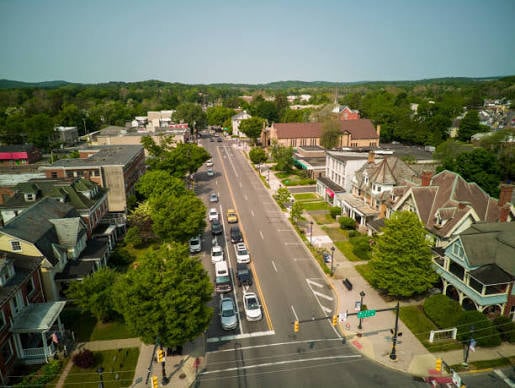
Pull the borough out of the county number and the story inverts. In the first quarter of 2026, Stroudsburg Borough was running at 2.1 months of supply and East Stroudsburg at 2.4, with the average listing pulling its first offer inside 31 days. The same three months that produced 162-day sales in the outer townships produced a tight, quick-turn market four miles up Main Street. Anyone shopping Stroudsburg using county averages is pricing offers to the wrong game.
Why the borough runs hot when the county runs cool
The county's slow half is dominated by two kinds of inventory: resort-community homes built as second properties and larger-acreage listings priced against the 2022 market. Both are interest-rate-sensitive in a way borough housing is not. A weekend buyer from Philadelphia or northern New Jersey looking at a $650,000 lakefront in Blakeslee is doing the math on a discretionary second mortgage at 6.5%. That math has gotten worse, not better, and the Pennsylvania Association of Realtors' mid-year update with Bright MLS chief economist Dr. Lisa Sturtevant made clear that 6.5% is roughly where rates are expected to sit through 2027.
Borough buyers are running a different calculation. They're comparing a $295,000 three-bedroom in walking distance of Main Street against a rental payment, not against a second-home fantasy. The primary-residence buyer at that price point is less rate-elastic. When rates tick up, they stretch. When inventory is short, they compete. That's why 19% of Q1 borough listings still took a price cut but the average cut was only $9,200. Sellers are trimming, not capitulating.
What the mid-year state read looks like at the zip code
Sturtevant's characterization of the 2026 market was that May was "the first time, frankly, that we're seeing a little bit of signs of life," with buyers coming to terms with rates in the 6.5% range. At the state level, Pennsylvania's median sale price in May 2026 was $318,867 with a median 36 days on market and inventory up 6.8% year over year, per Redfin's Pennsylvania state tracker.
Stroudsburg's borough numbers are running ahead of that state pace on speed and behind it on price. Faster turnover, lower absolute prices. That is not a coincidence. It's the shape of a market where the housing stock is older, denser, and priced under the state median, so it clears the affordability bar for a wider pool of buyers even at current rates. The friction that's showing up in resort inventory and $500,000-plus county listings simply isn't landing on a $260,000 twin on Sarah Street the same way.
What this changes about your offer
If you're comparing Stroudsburg to other Pocono submarkets, three tactical points follow directly from the data:
- The 31-day first-offer window is your clock, not the seller's. In the borough, waiting a weekend to see if the price drops is how buyers lose houses. In Tobyhanna or Blakeslee, waiting a weekend is how buyers save $15,000.
- Price-cut math cuts both ways. A 19% price reduction rate sounds like leverage until you realize the average cut is $9,200 on a $295,000 median price. That's a 3% adjustment, not a 10% one. Coming in with a lowball is a rejection letter, not a negotiation opener.
- The cash share is the single most useful number in the dataset. With 22% of Q1 transactions closing in cash, financed buyers on the desirable borough listings are competing against a fifth of the offer pool that can waive appraisal and close in two weeks. Pre-approval isn't sufficient prep here. Fully underwritten pre-approval, a documented earnest money source, and a realistic timeline for inspection contingencies do more to win these homes than an extra $5,000 on the top line.
None of this shows up if you're reading county-level Redfin. The county number blends a fast borough with a slow resort ring and produces an average that describes neither.
The cash-buyer factor deserves its own paragraph
Twenty-two percent cash is high for a market at this price point. It reflects two overlapping pools of capital: New York and northern New Jersey buyers cashing out equity from higher-cost metros and paying outright for a smaller Pocono primary home, and small-scale investors buying older borough duplexes and single-family rentals. Both groups skip the appraisal friction, which matters in a place where the housing stock is old enough that appraisals occasionally come in soft on cosmetically dated homes. If you're financing, that's the specific transactional friction to plan for. An appraisal gap clause, or a willingness to cover a shortfall within a defined range, is often what separates the accepted offer from the second-place one in the borough right now.
Frequently asked
Does the split hold across the whole borough, or are certain streets acting more like the county? Larger, older single-family homes above roughly $450,000 in the borough behave more like the county pattern. They sit longer, take deeper cuts, and see less cash competition. The tight-market dynamics are concentrated in the entry-to-mid range, roughly $200,000 to $375,000.
If rates drop, does the county catch up to the borough, or does the borough get hotter? Both, but not equally. A meaningful rate move first pulls the discretionary second-home buyer back into the resort inventory, which is where the current slack sits. The borough is already running near capacity for its inventory level, so a rate cut there translates more into price pressure than volume.
Is the borough number distorted by the small sample? It's a fair question. Q1 had 205 new listings across the two boroughs combined, which is enough to distinguish signal from noise but small enough that a single well-priced or badly-priced listing moves the average. The direction of the split is robust across every metric measured. The exact magnitude on any one number should be read as a range, not a point.
The reason to care about this now is that the next six months are the part of the year when the split usually widens. Borough inventory tightens through late summer as families settle before school, while resort inventory builds through fall as sellers give up on the summer window. If you're targeting Stroudsburg specifically, the county-average narrative that helps a buyer in Blakeslee will actively hurt you here.
If you want a read on a specific street, a specific price band, or a specific listing that's been sitting long enough to look like leverage but might not be, that's the conversation to have before you write the offer. Kacey Conaty works these blocks every week and can tell you which of the county-average signals apply to the home you're actually looking at and which ones are noise. Contact Kacey to start your Pocono search.